

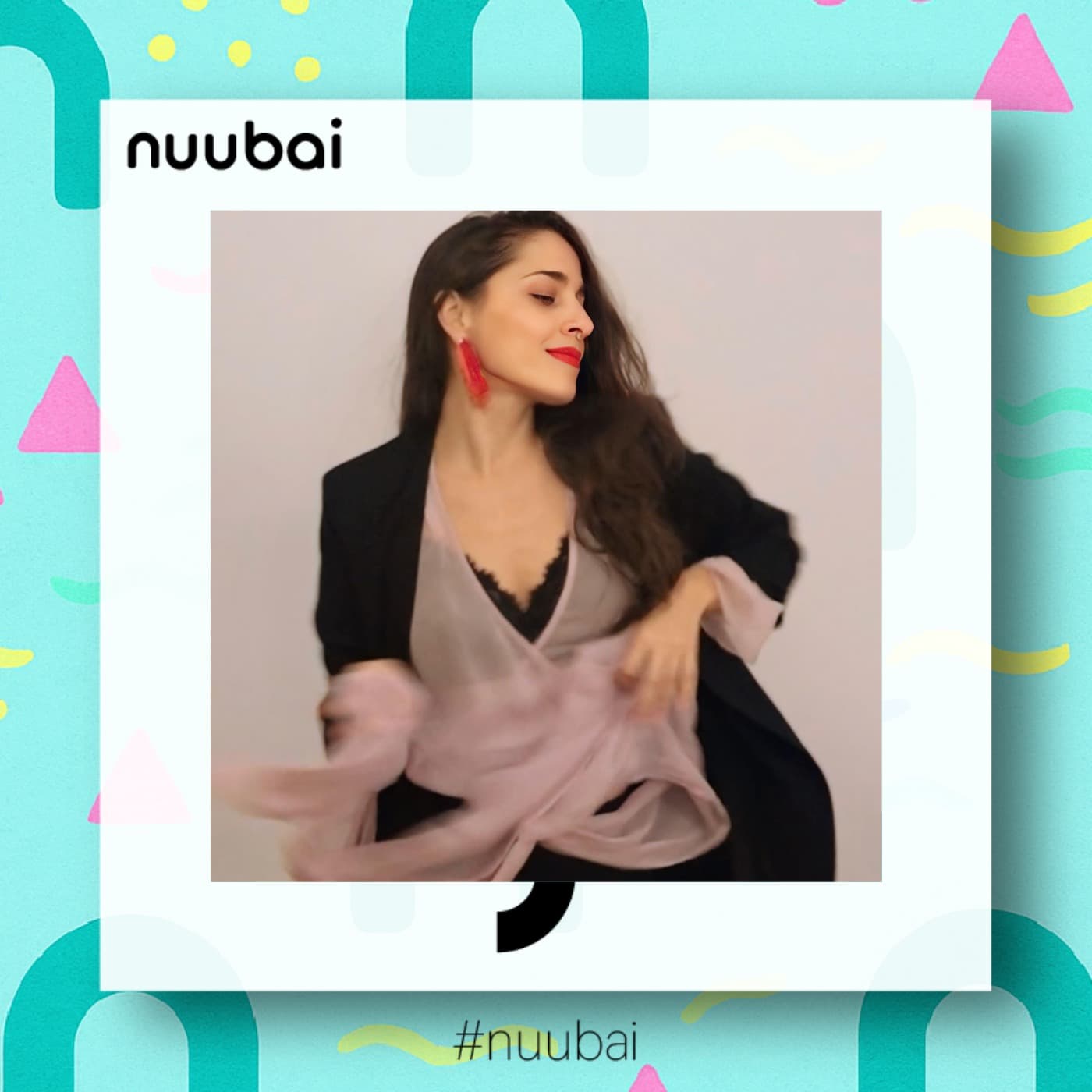
Sara Alhinho, the girl-woman from whom surprises are always expected, offered us two songs wrapped in crepe paper — music videos that are also tiny short films, full of creative detail.
Musically, Sara showed us a place that had perhaps been sitting in a small drawer lined with flower-scented paper, never quite proposed during her career — though the sketches were always there.
Burlesque is an artistic and performative style defined by parody and exaggerated humour. It evolved from the satirical literary works of the sixteenth century into the variety shows of the dance halls of the nineteenth and twentieth centuries, where it established itself through extravagant costuming. In its contemporary expression — neo-burlesque — it has also become a space of glamour and artistic assertion. This text touches on that neo-burlesque, and only its artistic and musical dimension — allow me the pure festivity and felt dance that in fact define the new era of burlesque. I was tempted, but I will not use the word "vintage" here. It has been so worn down and so often used without meaning that it now appears on everything — in the same basket as words like "resilience," "empowerment," "coaching," and the rest.
But let us return to our Sarita.
As a language, burlesque is born from play, from the grotesque embraced openly, transforming the serious into scenic game. In performance — above all in theatre spaces — it crosses dance, humour, and subtle eroticism, with iconic figures marking the modern imaginary. It is in that symbolic territory that a space emerges where singers draw inspiration from a new reading of the divas of other eras. Music played in rooms where the classic piano-and-voice setup mingles with floating scarves and the mark of "lady of the wing" — but also on grass in conversation with slices of watermelon, scattered petals, and coloured seeds, small details that enchant. Polka-dot dresses, sea-blue garden benches that whisper of a lampshade (or something that leads us there), shades of pink, and at the back of the biscuit table, a discreet bottle of grogue — because without it, "Manche" would be difficult. Add to all of this a (care)less set design, the sound of a radio resting on the table, and as the final wrapping, the ever-present smile of Sara Sarita — never excessive, never gratuitous.
I confess: I like videos where you can feel the flavours, the smells, the wind. Where the music gains body and reason. Something sorely missing from many videos produced in our islands, so often locked into a standard template that would serve equally well for João, Manuel, or Joaquim.
Even knowing this video was made with far more creativity than budget, it stands clearly apart from the national output. As was already the case with "Lady of the Wind" — in "Manche," imagination beats the budget. The movement of the scarf, undefined in colour but striking, merges with Sarita's smile, which almost breaks free — or is slowly breaking free. The scats arrive when needed, the set serves the music: nothing excess, nothing missing.
Sara Alhinho has that rare gift: using only the essential without losing what she wants to say. Here, well anchored by Aupperle's piano, she builds a coherent universe — and coherence, it is worth noting, is something rare in our music.
She does not abruptly abandon the intimate register of voice and piano, where the influences of the neo-jazz divas of the late 1990s breathe through the first video — but she also drinks from the heirs of neo-swing, who in turn drew from the classics of earlier decades. Across both videos, Sara expands that space. The imaginary room opens into a garden, friends arrive, morning greetings at dawn, and a contained but luminous joy in the beautiful recovery of "Manche."
It is the same celebration without excess — intense and light at the same time. The same environmental design of the first record, now with clear brushstrokes of neo-swing made in the 90s, evoking — lightly, and without direct comparisons — Cherry Poppin' Daddies, Brian Setzer Orchestra, or the magnificent Big Bad Voodoo Daddy.
Sara's ability to connect what she feels — painted in the smile — to the musical moment is remarkable. There are no late smiles, no early ones; that is precisely why they are natural. And they enchant as she sings.
Sara blends all of this and brings to Cabo Verde a sound that quickly reveals itself as something that can adhere to our coladeira. It was, without question, clear innovation. I believe that is where much of her magic resides. It brought to mind another brilliant incursion into the sounds of the 1960s and 70s, when Khyra entered the universe of Frank Cavaquinho in a soul of absolute mastery — the impressive Frank Brock, unjustly forgotten.
Sara was original. She stepped away from the sameness that so often dominates national production and that, more often than not, is mistaken for innovation. I had not seen it in a long time — with honourable exceptions. Sara was not afraid to move.
I speak, for now, of the first two singles. But when singles are well conceived and follow a concept — as everything suggests is the case with the Sara Alhinho Quartet — they become a sign of good harvests to come, fertile ground, and genuine difference in our music.
Sara exploded into freedom. There is, definitively, a new Sara Alhinho that was born — coincidence or not, to speak of birth here…
I wait for the album and the shows, with curiosity and real enthusiasm.