

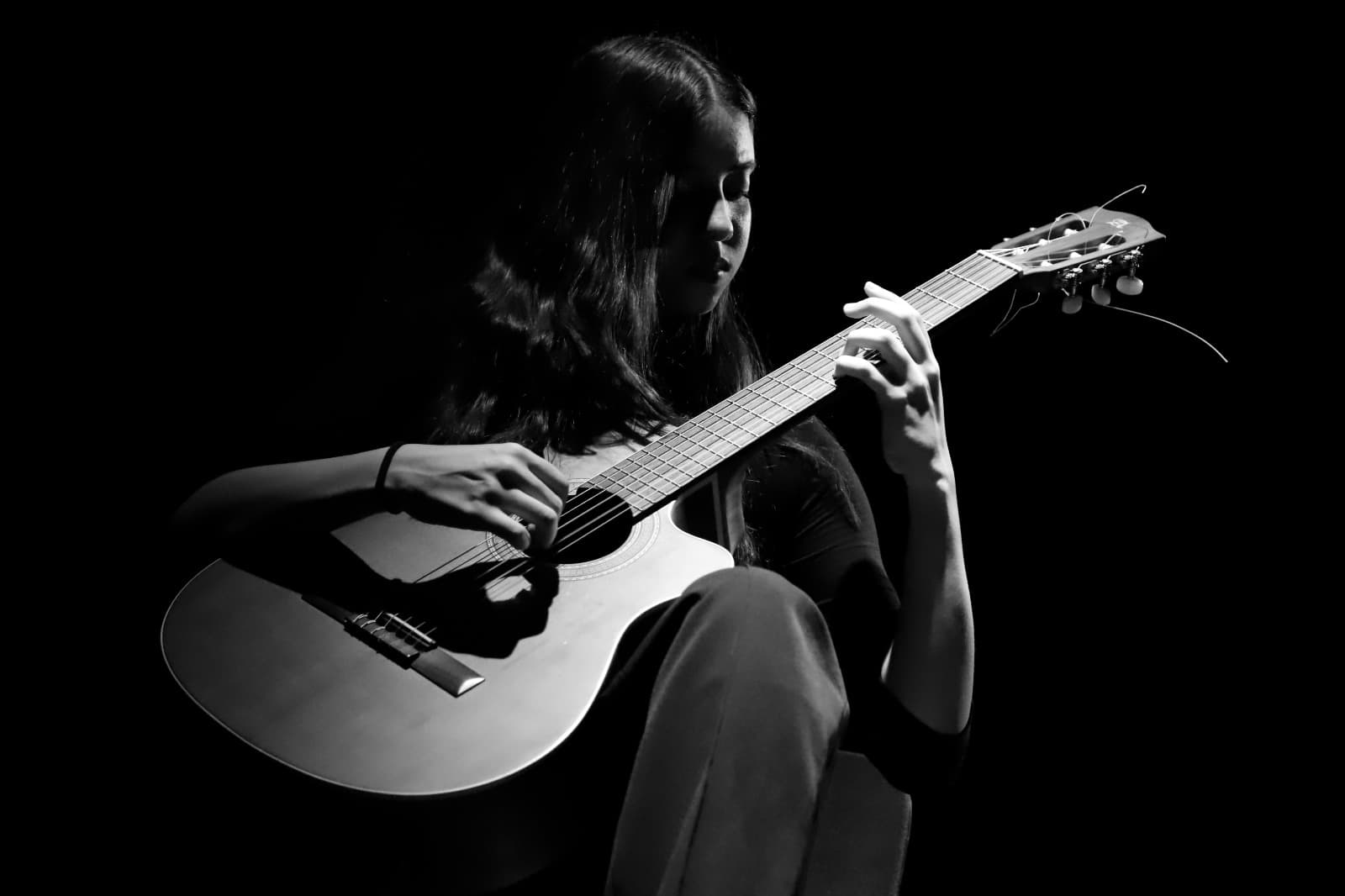
Still a child, Gabriela chose guitar lessons at Escola Pentagrama, in a welcoming little room where the walls hold so much music.
It was in that room that Gabriela grew, learning and filling herself with music. Always attentive by her side was Professor To Tavares, who for 30 years has taught music to countless children. But To taught, above all, how to love it. How to discover the beauty of art itself.
Some chose to make music their profession. Gabriela was one of them.
Today, she pursues her studies in a distant country. She carries with her everything she has learned and dreams of returning with knowledge in her suitcase, to contribute to the music of the islands.
In conversation with Gabriela, we understand that path better.
When did music stop being just a passion and become a life choice?
When I was almost finishing secondary school I realised that I wanted to pursue music as a profession and not just a hobby. I don't think there was a specific moment when I decided, it simply made sense that this was what I should do and it was what made me feel good.
Choosing music as a profession also means accepting a certain insecurity. Were you afraid of making that decision?
My only fear was how my parents would react because their opinion matters a lot to me, but that fear disappeared quickly because I saw that I would always have their support. Professor Tó always showed me that there's no need to be afraid and that with work and dedication everything is possible.
You left Cabo Verde to study music in Hungary. What were you looking for when you left?
I was looking for an opportunity to study music as higher education because here in Cabo Verde we don't have such a course, and there I found exactly what I was looking for at the time.
What is your course called and what does it consist of?
My course is called Music Culture and it's basically, as the name says, the culture of music. We study music in general (history, theory, solfège, folk music, etc.) and also in the last year of my course we have a specialisation in Computer Music and Production.
What has distance taught you about Cabo Verde and its music that perhaps you wouldn't have understood if you had stayed?
Being in Hungary and learning a bit about their culture I also realised that our music is very rich.
In your course, you'll be able to work on putting our music into notation. When you put traditional music on a score, are you preserving a memory or are you also, in some way, transforming that music?
With just the course I'm taking right now I can't do that yet, which is why after this I want to do a master's. I think that by putting it on a score we are preserving the music and also giving more chances to other people from other places to also interpret and appreciate it.
Are there things in an oral tradition that written music can never capture?
I think so, because for example, no matter how much we say we have a morna written perfectly on a score, still only a Cape Verdean can interpret it in a deeper and more faithful way and put their soul into it.
You studied in schools, but you also learned with musicians and masters. What can school teach and what can only be learned by standing beside someone who plays?
School teaches the academic and technical part that helps us perfect and improve the way we play, while the more traditional part teaches us to interpret music in a deeper and more traditional way.
Professor Totavares holds an important place in your journey. What did you take from him, musically, but also in the way you understand music?
Professor Tó is a great inspiration and motivation for me. He is a great example of discipline, determination and focus, which are very important factors in music.
What do you think your generation can learn from older generations? And what can your generation bring to that tradition?
I think my generation can learn mainly in terms of experience, discipline and respect for music and tradition. They have knowledge that you don't learn just in a classroom. At the same time, I think my generation can add new ideas and new ways of interpreting and sharing music.
There's often talk of the need to preserve traditional music. But does preserving mean keeping it exactly as it was received? Or does a tradition only stay alive if it can also change?
I think preserving traditional music doesn't necessarily mean keeping it exactly as it was received. Tradition stays alive when it's passed on to new generations, and each generation ends up interpreting it in their own way and adding something.
You're away, but this work seems to have Cabo Verde as its destination. When you return, what would you like to bring with you?
Transcribing the music into notation is something I really want to do, but that requires specialisation and I'm looking for it.
What role would you like to play in Cape Verdean music?
Since I'm just beginning I'm not yet sure, but I would also like to focus on composition in the future.
What musical Cabo Verde would you like to help build, especially for those who come after you?
I'm not entirely sure yet, but I want studying music to not be seen as a "waste of time" or as something from another world and I also want studying music to be more accessible to everyone.
If today you had to choose between a safer life, but away from music, and a harder life, but doing what you love, would you choose music again? Why?
Yes, I would always choose this path again because it's what makes me happy and it's also what I know how to do best.
After everything you've lived through so far, what has music taught you about yourself?
That I am much more dedicated than I thought and that when I have interest in something I can focus and reach my goals.
What does music know about you that no one else knows?
I think music knows a part of me that I don't easily show to people, because I feel I have great difficulty showing my feelings and even expressing emotions. But I think I can convey everything I feel when I play.
Is music with you every day?
Yes.
What message do you leave for young people who want to follow the path of music?
With a lot of dedication and practice everything is possible.
Two songs and two composers or musicians on the soundtrack of your life?
The Neighbourhood and Mayra Andrade. These are two artists I listen to a lot.
Gabriela is far away, but she knows where she's going. Music has taught her to be dedicated, to focus, to believe that everything is possible with practice and determination.
The rest builds itself along the way.
- Picture by Helder Paz Monteiro